

The United Liberty Alliance is a civil Rights organization, an alliance of all the minority groups in South Africa and their respective organization, striving for the individual rights of each of the minority groups. Currently we are under the majority mob rule tyranny in South Africa. The United Liberty Alliance is focusing on the legal process towards external self-determination and secession from South Africa, where we can be free again, with our individual rights to Life, Liberty and pursuit of happiness. There are many individual organizations who are associated with the United Liberty alliance.
vision of the United Liberty Alliance
The ULA and its affiliate organisations envision a free and fair society where Southern Africa’s minorities can enjoy their basic human rights, without domination and oppression. The worsening situation in South Africa has shown, over more than two decades, that this vision is only obtainable through independence of those regions where these minorities are in fact the majority.
The ULA stands for the independence of all minority groups, and the right to govern themselves. The ULA believes in representative Government and in the confederacy, where each individual state governs themselves as sovereign states.
What is secession?
Secession is the process where a region of a group of people are breaking of, ending and cutting their ties from the original nation or particular nation to form a new nation, cutting al political ties with that specific nation from whom they want to secede, towards independence.
Are there any nation that seceded successfully or in the process of secession?
Yes, there are nations who successfully seceded from their original countries. The United States of America from Great Britain, the former Soviet republics leaving the Russian Federation.East Timor leaving Indonesia, Eritrea leaving Ethiopia, Bangladesh leaving Pakistan,Uruguay leaving Brazil. Greece and Serbia leaving the Ottoman Empire, South Sudan leaving Sudan, Panama leaving Colombia, as taken from the Real Clear History’s article on nations who successfully seceded from their original countries as written by Brandon Christensen,
1. The 13 American colonies leaving the United Kingdom: Was the American Revolution an act of secession or an act of patriots defeating a foreign imperial power? Contemporary thinkers and policymakers at the time (1775-1783) very much viewed the American Revolution as an act of secession rather than a country fighting its way out of foreign bondage. Everybody from Adam Smith to Edmund Burke to King George III to the rebels in British North America believed that the war between the two sides was a civil war between two different factions of the same polity: the United Kingdom of Great Britain and Ireland.
2. The former Soviet republics leaving the Russian Federation: By 1990, the largest experiment with socialism to date was rapidly failing for all the world to see. In 1991, a last-gasp military coup was attempted, to no avail, and 14 independent polities moved quickly to leave what was left of the Soviet Union before Russia could settle into the USSR’s old place as a world power unafraid to use to blunt violence to enforce mores and laws. The ramifications of this vast, multi-actor secession stretching from Central Europe to the Pacific Ocean are still being felt.
3. East Timor leaving Indonesia: The secession of East Timor from Indonesia, made official in 2002, lasted decades (beginning in 1975) and is responsible for the violent deaths of hundreds of thousands of people. Timor was a tiny Portuguese colony surrounded by the massive Dutch East Indies colony. When the Dutch left town, the local Timorese politicians thought it would be a good idea to declare East Timor’s independence. Portugal shrugged, but the country that replaced the Dutch East Indies – Indonesia – had other plans for East Timor and invaded it. East Timor is in bad shape today, but because of this there has been a marked increase in cooperation between Australia and Indonesia – two regional powers that have rarely seen eye-to-eye.
4. Eritrea leaving Ethiopia: All of the wars that Africa has seen since decolonization have at least some inkling of secession-minded action to them. Ethiopia, which in 1974 was governed by an old monarchy, descended into a civil war between monarchists and Marxists. Eritrea, which had once federated with Ethiopia voluntarily before being annexed years later, declared its independence during the chaos. The Marxists in Ethiopia won, and Addis Ababa appealed to the Soviet Union for help defeating Eritrean separatists. In 1991, once the Soviet Union collapsed, Eritrea – led somewhat ironically by Marxists – proclaimed independence and soundly defeated Ethiopia’s suddenly underfunded military. Today, it is a one-party state in a region (the Horn of Africa) wracked by conflict.
5. Bangladesh leaving Pakistan: We all know why India and Pakistan were split up, but why did Bangladesh (formerly East Pakistan) secede from Pakistan? While the people of Pakistan and Bangladesh share a common religion (Islam), the cultural, political, linguistic, and economic differences between the two countries are cavernous. London left most of the political power in the hands of Pakistan’s elite, which led to resentment in Bangladesh as well as very real economic disparities. In 1971, Bangladesh declared its independence from Pakistan and the two sides fought a brief but vicious nine-month war before Pakistan was forced to recognize the Bangladeshi secession as legitimate.
6. Uruguay leaving Brazil: In 1815, the South American continent was a mess. Buenos Aires was trying to assert itself as a regional power, and Portugal was trying to maintain power over its New World possessions. In 1825, the region of Cisplatina in the Brazilian south declared its independence from the Brazil (which had just a few years earlier declared its independence from Portugal) and sought protection by aligning itself with a country that was not yet called Argentina: United Provinces of the Rio de la Plata. A stalemate ensued, but the hostilities resulting from the inability of one side to land a knockout blow began to affect trade in the region. France and the UK then sat down with the factions involved and created the Republic of Uruguay as a buffer state between the two budding rivals.
7. Greece and Serbia leaving the Ottoman Empire: Like the North American and Algerian secessions, the violent exit of Greece and Serbia from the Ottoman Empire (in the early 1800s) was viewed as a civil war rather than as a patriotic struggle to overthrow a foreign oppressor. Greece and Serbia had been part of the Ottoman Empire for hundreds of years before seceding from Istanbul. Because history is written by the victors, these secessions are painted in a different light by most people today, but make no mistake: the independence of Greece and Serbia from the Ottoman Empire was not supported by everybody, and the narrative of the patriot expelling the foreign oppressor was shared by few people at the time, including a (albeit slight) majority of the region’s Greek- and Serbian-speaking Christians.
8. South Sudan leaving Sudan: These two are in the same neighborhood as Ethiopia and Eritrea, though their story is a bit different. Unlike Ethiopia, which managed to maintain its independence during Europe’s colonial venture in Africa, Sudan was just a large chunk of territory created specifically to keep other European powers out of British-ruled Africa. When the Brits left town, this vast territory became one of the world’s largest countries (by area) overnight. Things got ugly quickly, and South Sudan ended up fighting a 22-year war with Khartoum before officially seceding in 2011. The new country descended rapidly into civil war, leaving open the options for further secessions on the one hand, or an opportunity for yet another regional strongman to step into the void caused by war on the other.
9. Panama leaving Colombia: The year was 1903 and the United States of America wanted to build its canal through what is now Panama. At the time, though, Panama was a part of Colombia, which itself was just coming out of a four-year civil war. The Panamanian factions that supported secession did so because they really wanted the canal to be completed and the Colombian government had been dragging its feet for far too long. So, they invited the U.S. government to help “maintain the neutrality of the railroad in Panama,” and this led eventually to the 1903 secession of Panama from Colombia. The Panama Canal was completed in 1914.
These are the examples of nations who successfully seceded from the original countries and many like the USA and Panama are doing very good today.
What does the South African Law and International Law saying?
There are many among the Establishment and major Afrikaans parties and organizations that claim that it is illegal to secede or to have self-determination according to International Law. Are they right? The answer is no and I will set out the facts to refute what these Establishment people are saying.
Article 235: Self-Determination
The right of the South African people as a whole to self-determination, as manifested in this Constitution, does not preclude, within the framework of this right, recognition of the notion of the right of self-determination of any community sharing a common cultural and language heritage, within a territorial entity in the Republic or in any other way, determined by national legislation.
International Covenant on Civil and Political Rights
Adopted and opened for signature, Ratification, and accession by General Assembly resolution 2200A (XXI) of 16 December 1966 entry into force 23 March 1976, in accordance with Article 49
Part 1
Article 1
1. All peoples have the right of self-determination. By virtue of that right they freely determine their political status and freely pursue their economic, social and cultural development.
2. All peoples may, for their own ends, freely dispose of their natural wealth and resources without prejudice to any obligations arising out of international economic co-operation, based upon the principle of mutual benefit, and international law. In no case may a people be deprived of its own means of subsistence.
3. The States Parties to the present Covenant, including those having responsibility for the administration of Non-Self-Governing and Trust Territories, shall promote the realization of the right of self-determination, and shall respect that right, in conformity with the provisions of the Charter of the United Nations.
According to both South African Law and International Law we do have the right to Self-determination and external Self-determination. We can have it on grounds of political, social, cultural and economic development as well as religious and language. For example Afrikaners and also Boers can have their own country according to Law based on language, culture, economic and cultural heritage. Even if people like Ernst Roets wants to read in rates, there is no race read in here. So also do we as members of the minority groups among the White, Brown and Khoisan groups have the rights to secede and and external self-determination based on language, culture, religion, social and economic, as we are doing it through the United Liberty Alliance.
What parts of the country and minority groups are we talking about?
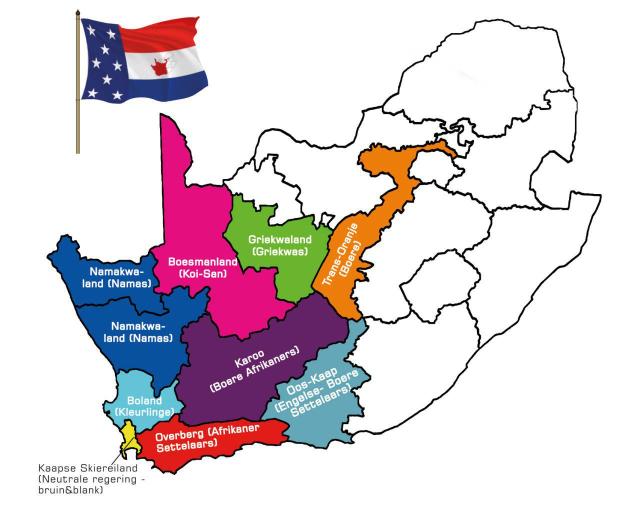
The parts that we are talking about are the Western portion of the Eastern Cape, Western Cape, Northern Cape, Western parts of the Freestate, portions of Western Transvaal en Central Northern Gauteng that also includes the far Eastrand and Bronkhorstspruit regions. This is where the eight sovereign states will come from. For the Khoisan groups Griekwaland for the Griekwas, Namakwaland for the Namas, for the San the Boesmanland. For the Cape Brown people and a number of White people, Boland. For the White Afrikaners and a number of English people, the Overberg, Eastern Cape for the Boers mostly and a number of English people, Karroo for the Boers and the Trans-Orange for the Boers. Then there is the neutral territory as the Confederal Capital Territory for the Confederal Government
The following people includes people groups from the Brown people, Khoisan, Caucasian (White people) and the Indian and Asian people. Among the Brown people, the Cape Brown people, among the Asian and Indian, Asian and Indian. Among the Khoikhoi, the Korannas, Griekwa and Namas. Among the San, the Bushmen. Among the Caucasian (White people) the White Afrikaners, the Boers, the English, the Portuguese and the Italian. These are the different people groups.
How far are we with the secession process and what still is expected?
The process is the international legal requirements for secession, which is a very long explanation on its own, but a process where at this stage closer to 97% of the international assessment process. Most of the process had been completed. That includes the assessment for the secession, how viable is it, how sustainable can it be, will it be economically viable and economically sustainable. What about the infrastructure, what form of Government, energy. All of these are completed and the findings is that it is viable economically, socially and social economically, as well as sustainable with infrastructure and energy. Also the form of Government will be a Republic in a confederate form.
All that remains to be done, is to get the mandate for secession from the people, we need at least 2 million, of which we still need to get more than 1.8 million to go. After the mandate from the identified groups of people came through, then a referendum can be called out. If the President refuses, then we through the ULA can declare independence, where we need only at least on UN member nation to recognize the independence of the newly created nation.
for the expats, vote for self-determination at http://www.voteforselfdetermination.co.za.
To our American Friends, this is what the United Liberty Alliance is all about, with many of the groups in alliance with the ULA, striving for independence, doing it the legal way. As minority groups and also from the United Liberty Alliance, we need your support. We also thank you fro your support so far for us. Will also help if you can speak to your governors, representatives in Congress as well as the Federal Senate at Capitol Hill, to put pressure on them to support our cause. We already have some senators on our side like Senator Ted Cruz, Senator Marsha Blackburn and others, we also already have the support from President Donald J. Trump and also Mike Pence, as as well as from Ann Coulter in President Trump’s office who supports us. We also thank you to the American Family Association, Tucker Carlson and also Rush Limbaugh and the OAN News.
 Americans Against Genocide of the Boers in South Africa