
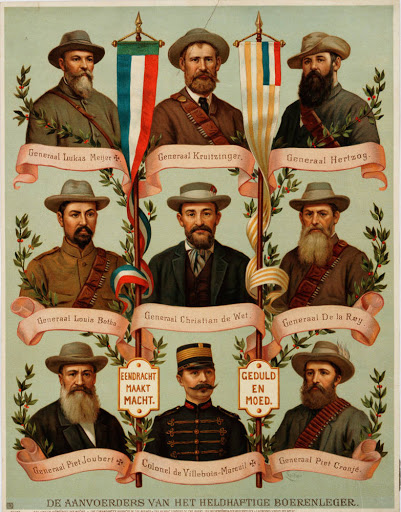
This is a very important question, which I want to give explain to our American people of who and what we are, where we come from and how we are shaped. First I need to start with the background of the Boer people, which includes the history and from where we were coming. Then also the different phases like the Vrijburgers Free Citizens, then the Trek Boer phase towards the Eastern Frontier, very much like the American Frontier men and pioneers. Then the Grens Boer phase on the Eastern Frontier very much like the Frontier Americans in Texas, Tennessee, Arkansas, Mississippi, Missouri, Louisiana, Oklahoma, New Mexico, Arizona and so forth. Then the Great Trek Phase and the Boer Republic Phase. Also the attempt by the Cape Afrikaners of the Western Cape who during the twentieth century tried to strip us of our identity and how we restoring our identity from the 1970’s, the next phase where the ANC is trying to wipe out our identity with the purpose to strip our rights to remain in South Africa and our fight to maintain our identity.
First I need to give a brief background of the Boers back in Europe while we were still known as the Dutch, German and French Huguenots. It was during that time when the Dutch had to fought for their liberty and religious freedom against the Spanish Catholics. The Dutch people were strict Calvinist Protestant people. This War, known as the Eighty Year War, which broke out in 1568 lasted till 1648 when the Catholic Hapsburg in Spain tried to suppress the Protestant faith of the Dutch people. The war shaped the Dutch people and also many of the Dutch migrated to the Cape during the war, fleeing for the religious freedom in order to live out their protestant faith free from the persecution by the Roman Catholic Spain. In 1648 the Netherlands was free at last. The Dutch East Indian Company was founded by the directors of 17 members, also known as the Lords XVII.
There was also the Protestant Germans, Lutherans who fought for their religious freedoms against the Roman Catholic. Most of the German Ancestors came from Prussia, Saxony, Schleswig-Holstein, Niedersachsen and Hamburg, who also joined with the Duct and many who also migrated to the Cape Colony for their religious Freedom, to be free from the persecution from the Roman Catholics.
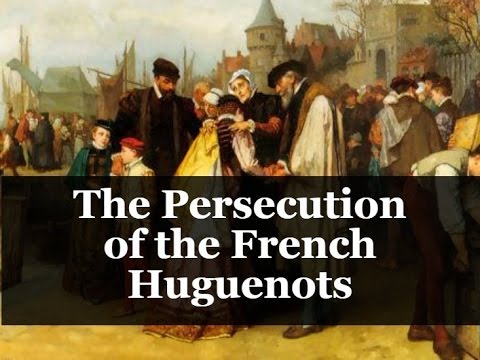
The third group is the French Huguenots. These were the Protestant French people who also suffered severe persecutions at the hand of the French Roman Catholics who tried to stamp out the French Protestants, known as the French Huguenots. The French Huguenots were severely and ruthlessly persecuted by the Roman Catholics. Protestantism was criminalized by the French Crown and the Protestant were not allowed to be armed at all which left them vulnerable to the savage persecution of the French Huguenots. The most known of the killings was the St. Bartholomew’s Day Massacre in 1572. Over 70’000 French Huguenots had been massacred by the French Roman Catholics by order of Catherine de Medici, Regent of queen and mother of King Charles IX of France.
In 1598 the King Henry IV issued the Edict of Nantes to give the French Huguenots Religious Freedom, which they’ve enjoyed and be able to defend themselves. But everything changed after King Louis XIV in 1643, where he started to disarm the French Huguenots and the persecution started against them again. In 1685 King Louis XIV enacted the Edict of Fontainebleau to make Protestantism illegal in France. May were killed and executed, and many more fled France to Germany, Netherlands and even England. One group fled to the American Colonies and others through The Dutch East Indian Company to the Cape Colony in 1688.
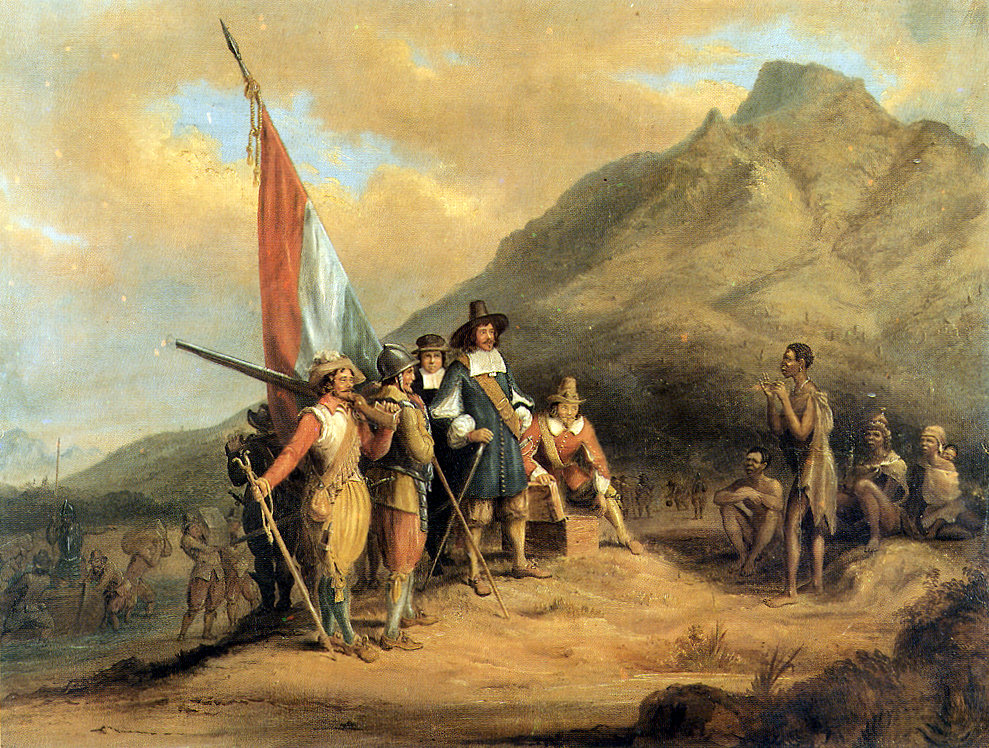
This is the back ground of the Ancestors of the Boer People in Europe, also with Norwayan, Sweden, Switzerland and Danish people who also contributed to the bloodline of the Boer People. Back to 1652, when the Lords XVII were making plans to establish a refreshing post at Table Bay at Cape Good Hope. They were working from Reports from Johan Appel who were in the Cape himself. Jan van Riebeeck was send to the Cape with a few Dutch Colonists who built the Castle at Table Bay, arrived April 6, 1652. From there the settlement had grown, Germans also arrived at the same time. During the time of Governor Simon Van Der Stel the French Huguenots arrived. Jan Van Riebeeck also allow the colonists to become the Vrijburgers (Free Citizens) having there own farms. The French Huguenots also joined the Free Citizens in the Cape Colony.
The Dutch people who move to the Cape for the sake of their religious liberty, the Germans with the same reason, religious freedom. The French Huguenots fled from France to the Cape Colony and the American Colonies. In the Cape Colony the French Huguenots mingled with the Dutch and Germans, forming the Boers. The Next phase, the Trek Boer Phase.
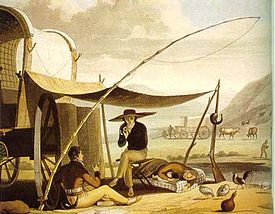
The Trek Boer Era started in 1679, when the Boers were trekking away from the Cape Town are Eastward as they are cattle farmers and sheep farmers. The Trek Boer Area lasted from 1679 till 1795. The were establishing towns like Franschhoek, Drakenstein, Stellenbosch, Swellendam and many more towns in the Western Cape, trekking from there into the Eastern Cape, founding Dordrecht, Graaf Reinette, Tarka Stad and many more. Some of the Boers also settled north of the Orange River and the Vaal Rivier. The Trek Boer Era also helped to shape the Boers and made the Boers tougher and with more bravery. The Bible in the Ox wagon and with the rifles for their own defense and also for hunting, strengthening their Protestant Faith.
The next phase was the Frontier Boers on the Eastern Frontier, where they met with the Bantu for the first time in 1776. They were plagued by the Bantu group, the Xhosa who raided their farms and houses and cattle, burning down houses and even killing many of the Boers. This led to a series of Frontier Wars as the Boers were defending themselves against the Xhosas, which further shaped their character and their hardiness, strengthening their faith in Christ Jesus. They were also met with the so-called missionaries from the London Mission Society who were so hostile towards the Boers in the Eastern Cape, justifying the Xhosa raids against the Boers. This went on until the Boers were having have had enough, which led to the next phase, the Great Trek.
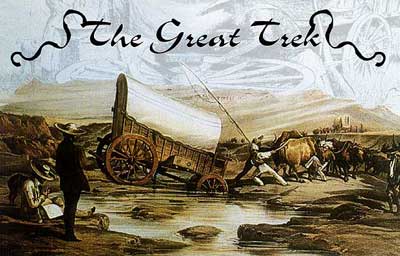
The Great Trek was officially from 1836 till 1852, although the first group Trek northward over the Great Orange River in 1834, Louis Trighard was the first one who led his group who ended in Mozambique. The second group was the Van Rensburg Trek. Then the legionary Hendrik Potgieter Trek, of which my great ancestor, Hendrik Frederick Prinsloo trek with Hendrik Potgieter and the Bezuidenhout Trek during the same time. It was also during the same time that the Battle of Vegkop took place in 1836 against Mzilikazi and his Matabeles who genocide the Bantu tribes in the Free State and the Transvaal Regions. Mzilikazi and his Matabele fled north of the Great Limpopo River again. In 1836 Gerit Maritz led his group of Boers in the Great Trek and also Piet Retief with his group. The Boers were meeting at Thaba Nchu to decide the next destination. Piet Retief were looking at Natal, planning to negotiate with Dingaan, King of the Zulu who assassinated his own brother, Shaka Zulu who built the Zulu Empire and nation. Hendrik Potgieter did not trust Dingaan and was proven right later on, which resulted in Hendrik Potgieter moving over the Vaal River with his group.
Piet Retief and Gerrit Maritz led their group over the Drakensberg Mountains into Natal. Piet Retief negotiated with Dingaan, later fought Sekonyela to retrieve Dingaan’s Cattle. Maritz, Sarel Cilliers and many more, including Reverent Gardener warned Retief against Dingaan, warning him not to trust Dingaan at all. But Piet Retief were too stubborn, went to Dingaan’s Capital, Umgungundlovo (Swallower of the Elephant). It was then that Dingaan ordered his impi’s to kill the Boers there and to go to Boesmans River and Buffalo River to attack the Boers there, killing men, women and children, even dashing the heads of the babies against trees and to ox wagon wheels and ripping babies from the wombs of the women. This led to the Boer Zulu Wars, including the Battle of Italeni, met with defeat.
It was at that time that Andries Pretorius led his group of Boers in the Great Trek over the Drakensberg, went up to the Vryheid area where he was elected Chief Commandant to lead the war against the Zulu. It was desperate times still with the death of Retief and his group fresh in their minds. It took Andries Pretorius to calm the Boers and getting the men together and ready for Battle. This led to a very important event of the Boers which would change the war in favor of the Boers.
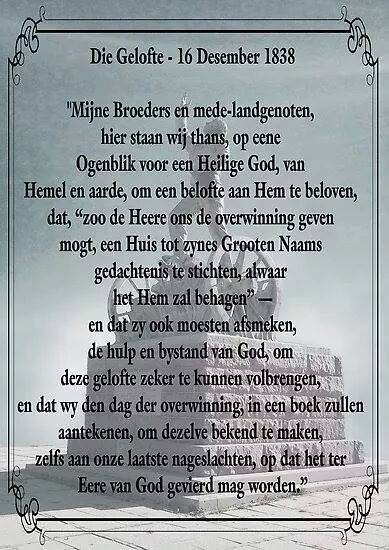
Andries Pretorius came with the decision to make a vow unto our Heavenly father and to pray before Him for His deliverance. Thus Andries Pretorius is the true father of the Vow. Here the Vow is going as follows as translated into English. “My brothers and fellow country men, here we stand on this moment before a Holy God of Heaven and Earth, to make a vow that, If the Lord give us the Victory, that we will establish a House in honor of His Great Name where it pleases Him. Also as we beg Your Help, as we will fulfill our vow before you on the day of victory, that we will sign onto the Book and dedicate the Day before you which we will remember and honor as a day of Thanksgiving and Sabbath, also to make Your name know, even to our descendants in honor unto You.
This Vow is also the Vow that further shaped the Boers for future generations. This was at the Ncombe River where the first victorious Battle will take place, to become known as the Battle of Blood River. The Ox Wagons were moved into a lager of a half circle, with the River on one side and the Canyon on the other side. There were in total only 465 men with their front loaders and musket. It was becoming completely dark and Dingaan’s Zulu Force were coming closer, with 18’000 men marching on to attack and to exterminate the Boers, the Boers were no match at all. But the mist prevented the Zulu Army to get closer.
The Following Day, December 16, 1838, the Battle took place. One wing were storming at a rapid speed, but due to divine intervention, the Boers were able to push down the attacks, killing many Zulu warriors who died in phase one. The one horn of the attack formation fall. The Zulu used toe Ox Head Formation, with the younger warriors forming the horns with greater speed to surround the enemy with the older men forming the head to attack and to stab with their stabbing spears, where no one can escape and all be killed by the Zulu warriors. The Boers in Pretorius Commando did not stand any chance at all and could face the death of all with the cattle be raided for Dingaan. But because of the divine intervention, God turned the tied of the battle and the Zulu were no match for God.
In Phase on, over 6000 Zulu warriors were slain, fallen into the river, staining the river red with their blood, giving the River the name Blood River. Phase two, the second horn regiment also stormed with the purpose to cut the Boers of and surround them, leaving them no escape, but they were also defeated, with the Canon Grietjie that fired one ball hitting the Central Regiment, the Head, killing of the captains and generals. In Phase two 6000 more Zulu warriors were slain and in phase three more ere slain and the rest fled. Dingaan was broken for the first time. Note, with Front Load Rifles and muskets that took a longer time to load, which is clear that God was with the Boers. After the battle, the Boers prayed to our Heavenly Father, thanking Him. Mpande and his group of Zulu people joined with Pretorius. More battles came forth, including the battle of Umfulozi, where Dingaan was defeated at last and fled into Swaziland, where he was killed. Andries Pretorius and his men suffered only three men wounded, and the took the bodies of their comrades including Piet Retief and buried them. They also find the Retief Agreement, which we still have.
In my next articles I will continue concerning of who and what We Boers are. What had been formed in we the Boers is that we are hardy, Independent, Freedom loving, Resourcefulness, self sufficient and very strong in our republicanism and very strong Protestant Christian Faith.. I will expand more on it in my next article.
 Americans Against Genocide of the Boers in South Africa